Monday, June 12, 2023

Diversity - A message from the DVTA President


A message from the DVTA President, Doreen South  ...  

Our constitution recognizes the equality and contributions of all people.  It is about inclusiveness.

 The DVTA promotes peace, healthy relationships, safety and security.  Our Durand Village apartment complex is a diverse community of race, gender identity, languages, spirituality. age, ability, degrees of wellness and philosophy.   

 
The DVTA is making an effort to recognize the acknowledgement of various peoples, demographics and populations within our community monthly


                 Please ... be an caring part of a respectful, responsible and inclusive caring community.


May is (was) Asian Heritage Month

The month of May is a time to celebrate, recognize and pay tribute to the AAPI people who have enriched our country’s history and culture.

The month of May brings Asian American and Pacific Islander Heritage Month, a time for us to celebrate, recognize, and pay tribute to the generations of people from these cultures who have enriched our country’s history and continue to make notable contributions today.

People who identify as Asian American and Pacific Islander, or AAPI, too often are overlooked in conversations about diversity, equity, and inclusion. I want to acknowledge and recognize this fact, while letting our AAPI colleagues and youth know that we see them and are committed to supporting their rights and opportunities in an equitable way. April 29, 2021


Asian Heritage Month is an opportunity for us to learn more about the diverse culture and history of Asian communities in Canada, as well as to acknowledge the many achievements and contributions of people of Asian origin who, throughout our history, have done so much to make Canada the country we know and love.

The theme for Asian Heritage Month 2023 is “Stories of Determination”, which represents the strides made and the challenges overcome by Asian communities to thrive in Canada over the last 2 centuries and beyond. It is a history filled with hardship and setbacks, but ultimately, it is a story of triumph over adversity. This month is also a reminder for all of us to come together to combat anti-Asian racism and discrimination in all its forms.


Official declaration of Asian Heritage Month

Diversity represents one of Canada’s greatest strengths, and we strive to ensure that all people in Canada have the opportunity to reach their full potential and participate in Canada’s civic life.

Over the last 2 centuries, immigrants have journeyed to Canada from East Asia, Southern Asia, Western, Central and Southeast Asia, bringing our society a rich cultural heritage representing many languages, ethnicities and religious traditions.

The people of these diverse, vibrant and growing communities have contributed to every aspect of life in Canada — from the arts and science to sport, business and government.

Asian Heritage Month offers everyone in Canada an opportunity to learn more about the history of people of Asian origin in Canada and to celebrate their contributions to the growth and prosperity of our society.

Thereby, we declare May as Asian Heritage Month in Canada.

Significant events in the history of Asian communities in Canada

Since the late-1700s, people of Asian origin have made important contributions to Canada’s history and identity. Each year, as part of its annual Asian Heritage Month campaign, the Government of Canada encourages all people in Canada to learn about how people of Asian origin have and continue to help shape Canada as we know it today. Below are just a few examples of the numerous diverse communities of Asian heritage which trace their ancestry back to more than 40 different countries, each with their own unique history and lived experiences.

https://www.canada.ca/en/canadian-heritage/campaigns/asian-heritage-month/important-events.html 


LGBT History Month

 https://lgbthistorymonth.com/background

Welcome to LGBT History Month.

LGBT History Month celebrates the achievements of 31 lesbian, gay, bisexual or transgender Icons. Each day in October, a new LGBT Icon is featured with a video, bio, bibliography, downloadable images and other resources.


About LGBT History Month

How It Works

LGBT History Month celebrates the achievements of 31 lesbian, gay, bisexual or transgender Icons. Each day in October, a new LGBT Icon is featured with a video, bio, bibliography, downloadable images and other resources.

LGBT History Is American History

“LGBT History Month sends an important message to our nation’s teachers, school boards, community leaders, and youth about the vital importance of recognizing and exploring the role of gay, lesbian, bisexual, and transgender people in American history."
George Chauncey
Samuel Knight Professor of American History and Chair of the History Department, Yale University

Background

In 1994, Rodney Wilson, a Missouri high school teacher, believed a month should be dedicated to the celebration and teaching of gay and lesbian history, and gathered other teachers and community leaders. They selected October because public schools are in session and existing traditions, such as Coming Out Day (October 11), occur that month.

Gay and Lesbian History Month was endorsed by GLAAD, the Human Rights Campaign, the National Gay and Lesbian Task Force, the National Education Association and other national organizations. In 2006 Equality Forum assumed responsibility for providing content, promotion and resources for LGBT History Month.

Celebrate Our Heritage

The LGBT community is the only community worldwide that is not taught its history at home, in public schools or in religious institutions. LGBT History Month provides role models, builds community and makes the civil rights statement about our extraordinary national and international contributions.

About Equality Forum

Equality Forum coordinates LGBT History Month, oversees the application for and installation of government-approved LGBT historic markers, produces documentary films and undertakes other high-impact initiatives. Equality Forum runs these innovative programs in collaboration with learning institutions, professional associations, research centers, for-profit companies and nonprofit organizations. For more information, visit www.equalityforum.com.


 2022 ICONS


Choosing food or paying rent.


A new poll shows the majority of Ontario renters are having to choose between food and paying their rents. When it comes to housing affordability, this province is on fire.

With a provincial election just days away, the housing crisis is top of mind for many. With each passing month, rental rates are soaring across the province. Compared just to this time last year, average rents for a 1-bedroom unit have increased almost 13% in Toronto, 15% in Burlington, 12% in Guelph, and almost 10% in Hamilton. Rents have risen in a province that already has some of the highest in the country.

Decades of austerity driven policy are forcing renters across Ontario to continuously try to make do with less. Wages, of course, have not kept pace with rising costs of living. A minimum wage of $15/hour still lags behind what Ontarians need to live. Experts have demonstrated a living wage should be much higher than that – in Toronto, for example, a living wage is $22.08/hr.

Some may blame the dire affordability crisis in Ontario solely on the pandemic. However, rental costs had been on the rise before the pandemic, just as wages had failed to keep up. The pandemic exacerbated the crisis, but it did not create it. What’s more, the pandemic has had widely differing impacts depending on wealth. The pandemic itself has been very, very kind to the most wealthy among us. A new report from OxFam International has found that “billionaires have seen their fortunes increase as much in 24 months as they did in 23 years,” and “the combined crises of COVID-19, rising inequality, and rising food prices could push as many as 263 million people into extreme poverty in 2022, reversing decades of progress. This is the equivalent of one million people every 33 hours.”

What does this global money grab look like in the context of Ontario?

Ordinary Ontarians are the ones being sacrificed in the name of profit as the financialization of housing continues – and renters are feeling the impacts most of all.

ACTO commissioned EKOS to conduct a province-wide poll of Ontario renters this month. We now have the results of the poll, and the findings are stark. Renters are being squeezed in an extreme affordability crisis that affects them in every single part of their lives, and very little is being done to help them.

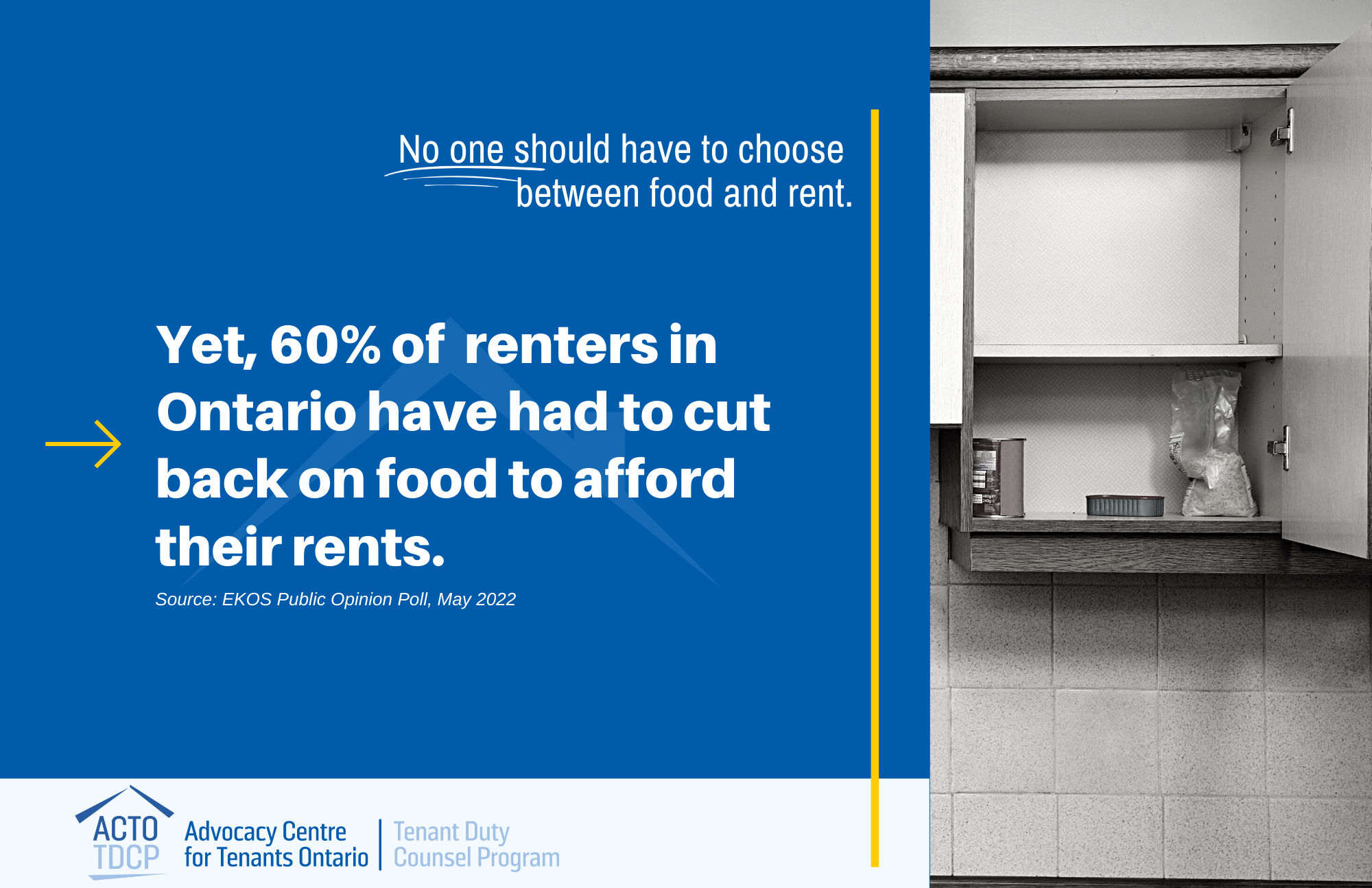
Picture of empty cupboard with minimal food. White text on blue background reads "No one should have to choose between food and rent. Yet, 60% of renters in Ontario have to cut back on food to afford their rents. Source: EKOS public opinion poll, May 2022." Logo reads: "Advocacy Centre for Tenants Ontario."

No one, anywhere, should have to choose between food and shelter. And yet in Ontario, that’s exactly what we’re seeing – 60% of renters said they have had to cut back on food to afford their rents. 74% had to cut back on their other spending to afford their rents.

Picture of hands holding open an empty wallet. White text on blue background reads "Soaring rental rates force Ontarians into financially precarious situations. 65% of low-income renters in Ontario would not be able to pay their rent over the next 3 months without taking on debt if they lost their income. Source: EKOS public opinion poll, May 2022." Logo reads "Advocacy Centre for Tenants Ontario."

These soaring rental rates are pushing more people with lower incomes into very precarious financial situations. 65% of low-income renters would not be able to pay their rent over the next 3 months without taking on debt, should they lose their income.

Understanding poverty is not just about measuring household income – it means we also have to look at how much people can save and how long they can cover their basic costs if they were to lose their incomes. Anyone who pays 50% or more of their income towards their shelter is at a very high risk of becoming homeless. Ontario renters are balancing on a knife’s edge to stay housed.

Affordable options for renters are dwindling

Image of toys and boxes being packed up for a move. White text on a blue background reads "Ontarians are struggling to stay in their communities because of skyrocketing rents. 1 in 3 renters have recently considered moving to a different municipality due to an increase of rental costs. Source: EKOS public opinion poll, May 2022."
Logo reads "Advocacy Centre for Tenants Ontario."

Renters are struggling to stay in their communities. 1 in 3 renters have recently considered moving to a different municipality due to an increase of rental costs. This means uprooting them, their families, possibly their jobs – every part of their life just to find a home they can afford. Even for people who are considering sacrificing so much are discovering that rents remain unaffordable almost everywhere, and competition for what’s available remains fierce. Their options for affordable, safe and secure housing dwindle day-by-day.

The solutions are multi-faceted, but one place to start is bringing back real rent control

We can’t afford to wait. Interventions to make housing more affordable should have been made years ago. Focusing on supply-side solutions won’t do enough, quickly enough, to stop the free-fall into poverty and increased risk of homelessness people are facing. One thing that the province can do overnight is instate real rent control in this province. This means scrapping the failed 2018 exemption for rent control on new builds, and getting rid of the long-standing policy of vacancy decontrol.

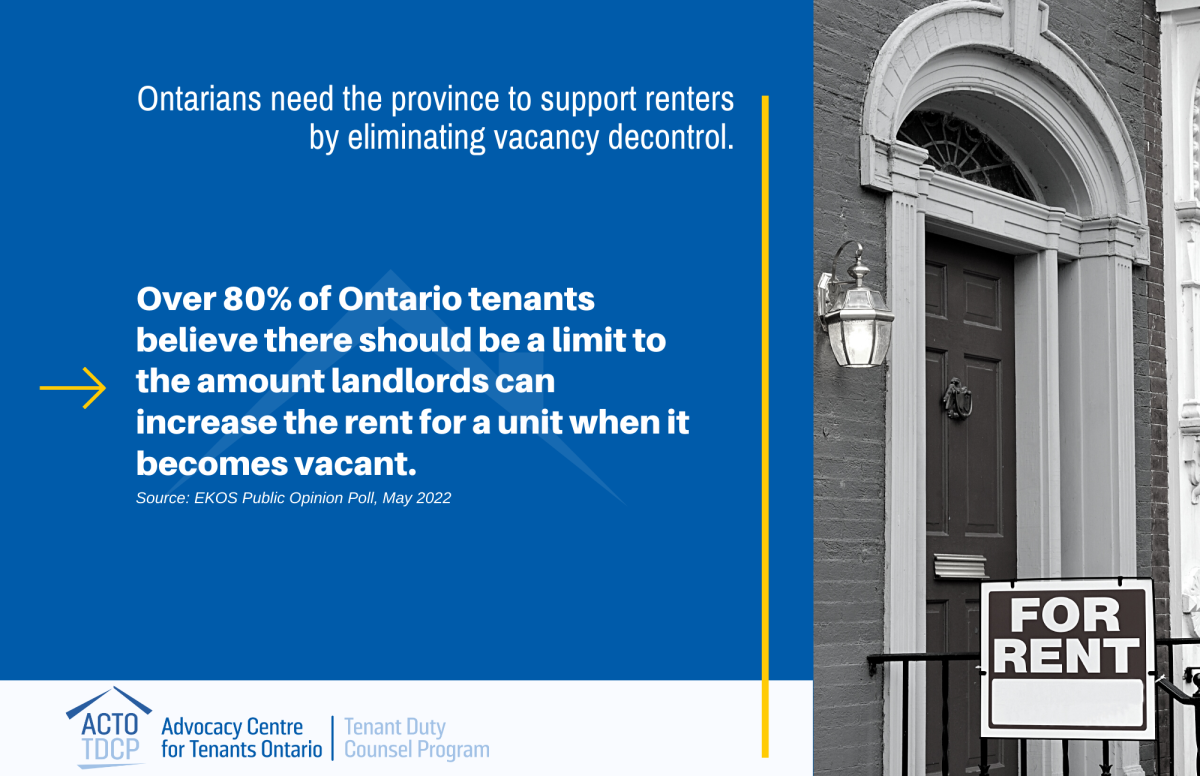
Image of residential house with a For Rent Sign out front. White text on blue background reads "Ontarians need the province to support renters by eliminating vacancy decontrol. Over 80% of Ontario tenants believe there should be a limit to the amount landlords can increase the rent for a unit when it becomes vacant. Source: EKOS public opinion poll, May 2022." Logo reads "Advocacy Centre for Tenants Ontario."

Eliminating vacancy decontrol is a popular idea among renters. Over 80% of Ontario tenants believe there should be a limit to the amount landlords can increase the rent for a unit when it becomes vacant. We agree.

We encourage all Ontarians to reflect on their housing priorities, and look closely at each provincial party to see what’s on the table in this election. The stakes for renters could not be higher.


Renting with a roommate in Ontario? Here are the rights and regulatiojs you should know.


Renting with roommates in Ontario? Here are the rights and regulations you should know.

Are you one of the many people in Ontario living with roommates? The amount of roommate households in Canada has grown by approximately 54% since 2001 and is currently the fastest growing household type. In Ontario, there are several types of co-living arrangements you can be a part of; however, being able to tell which one you fall under can be difficult. Here are some of the most common roommate arrangements in Ontario

1. Joint Tenants

What they are

  • A joint tenancy is the most common co-living arrangement landlords use when renting to two or more adults.

What to consider

  • All tenants can be evicted for a breach of tenant obligations such as arrears or property damage.
  • If any rent or other money is owed to the Landlord, all tenants listed under the lease can be considered responsible for paying the full amount. In the case that you and your roommate(s) agreed to split the cost, you can still be held responsible if you paid your share and your roommate(s) did not.

2. Tenants in Common

What they are

  • Two or more tenants live in the same unit together, however they have separate leasing agreements. 
  • Each roommate pays their individual rent to the landlord separately.

What to consider

  • Unlike with a joint tenancy, if one of the tenants does not pay their part of the rent, the landlord can only hold that individual tenant liable.
  • Landlords may have a difficult time working with these types of lease agreements, and typically prefer a joint tenancy agreement.

3. Tenant/Occupant

What they are

  • Occupants are people who consider the unit their primary residence, but, unlike a tenant, are not on the lease. As they are not on the lease, they are not formally responsible for paying rent to the landlord – only those listed as tenants in the lease are. They may have an arrangement to pay the tenant part of the rent.
  • Common examples of occupants include: some spouses (married or common law) and/or children. Anyone can be an occupant based on the leasing agreement and whether they have permission from the landlord. Many “Roommates” are occupants, although some may be joint tenants or tenants in common.
  • Anyone under 18 who is a dependent of the tenant is an occupant by default.

What to consider

  • In some cases, since the occupant may not be covered by the lease, the occupant has little to no rights or control over their living in the residence.
  • Occupants are unable to bring issues they have with a tenant or landlord to the Landlord and Tenant Board.
  • If a tenant is evicted, the occupant will need to leave as well.
  • Tenants are solely responsible for paying rent to the landlord but can choose to divide rent with an occupant in the amount they see fit, or as agreed to in a separate contract. .
  • In a scenario where the occupant is someone renting from the tenant, it is generally recommended that a contract be made. If a contract has been formed, the occupant can take the tenant to court if the terms of their agreement are not being met. Keep in mind that the judge will look at the case based on contract law, not based on the RTA.

Sometimes, a tenant can be incorrectly labelled as an occupant. It’s important to know how you are protected under the law, if you are unsure whether you are a tenant or occupant, seek legal advice.

RTA-exempt Arrangements

What they are

  • In an agreement exempt from the Residential Tenancies Act, relations between the owner and those occupying the property are decided solely by the contract that has been made.
  • Examples of RTA-exempt arrangements include living directly with the landlord or a family member of the landlord, living in a student residence, living in hotels, motels, and/or vacation homes.
  • Unsure if your living arrangement is RTA-exempt? You can find a full list of RTA exemptions here. If still unsure, it is best to get legal advice.

What to consider

  • RTA-exempt agreements do not need to follow rent control guidelines.
  • The RTA provides timelines for eviction that won’t protect renters who are exempt from the RTA.
  • If you are in a RTA-exempt agreement, you cannot pursue legal action against your landlord at the Landlord and Tenant Board, but you can take them to court if there is a breach of contract. The court will look at your case based on contact law, rather than the RTA.
  • Landlords will sometimes falsely claim that a tenant is exempt from the RTA to undermine their rights. If you think your landlord might be doing this, seek legal advice.
  • Being under an RTA-exempt agreement does not automatically mean you have no protections under the RTA. Seek legal advice to find out the ways in which the RTA applies to you.

It’s not always clear what roommate agreement applies to you. It’s important to know where you stand legally to best protect yourself. We recommend that you pursue legal advice to get more information and guidance on your specific situation.

Do you want to learn more about your rights as a renter? ACTO has developed tip sheets and guides, which can be accessed here.

Lack of Effective Rent Control


The real reason Ontario’s rental market is broken? Lack of effective rent control.

Ontario’s rental market is broken. Vacancy rates have reached historic lows in 2022 for many Ontario cities, according to CMHC’s recently published annual Rental Market Report. A majority of cities saw vacancy rates drop dramatically to 1.9% or lower; the lowest rates have been since 2001. Average rents in major Ontario cities have risen anywhere from 5 to 12% compared to last year. That figure soars higher for condiminiums. To put it simply: we don’t have anywhere near enough rental housing supply and what is available is eye-wateringly expensive.

For the first time ever, the CMHC report shows the impact vacancy decontrol has on the rental market. Vacancy decontrol is a policy that allows landlords to charge any rent they want for a unit that is unoccupied, regardless of what the previous tenant paid. The report noted that the average rent across Canada for a two bedroom unit that turned over saw an 18.2% increase. When compared to units with existing tenants, however, the increase was only 2.8%.

How does rent control currently operate in Ontario?

Existing tenants in Ontario are protected by rent control; meaning the landlord can only increase their rent each year up to the limit set out by the province. It used to be that rent control applied to all units, even ones that were turning over. However, in the mid-1990s, the policy of vacancy decontrol was introduced. Rental prices have soared ever since. The CMHC report found that in 2022, vacancy decontrol sharply increased rents for two bedroom apartments that had turned over by 26% in Hamilton, 17% in Ottawa, and 29% in Toronto – compared to 1.2% for existing tenants.

Rent control also doesn’t apply to rental units that were first occupied on or after November 15th, 2018. For those unfortunate tenants, they have no protections at all. Their landlords can raise the rent by however much they want. And raise it they do – we’ve had tenants coming to us in crisis because their landlords have demanded increases of 20% or higher and they can’t afford to pay it.

Policy-makers justified vacancy decontrol and the 2018 loophole because they claimed it would increase supply. These changes also came at a time when governments largely stopped investing in co-ops and other forms of affordable housing. Thirty or so years later, we still don’t have enough supply. Ontario needs to build at least 10,000 new rental units each year to meet the demand of a growing population. However, we’ve seen an average of only 5,500 rental completions annually over the period from 1990 to 2020. That’s approximately half of what we need. After decades of these policies, there is no evidence to suggest vacancy decontrol increases supply at all.

The real cost of vacancy decontrol

What is clear, however, is that vacancy decontrol and the 2018 loophole are a total disaster for housing affordability. It has become so dire that even a major Canadian bank is calling for Canada to double its supply of subsidized housing, sharing that Canada has one of the lowest rates of subsidized affordable housing of all the OECD countries – a paltry 3.5% of housing stock.

What does this tell us, in practical terms? Instead of creating more supply, these policies have incentivized landlords to evict tenants from their homes so they can make more money off a new tenant. It also means even if we do build more supply, anything new entering the rental market is going to be unaffordable, because it’s exempt from having any rent control at all. Renters will be forced to cut back on other basic necessities (like food) just to stay housed. Evictions (both formal and informal) will continue unchecked. It means more renters will be at risk of homelessness.

It doesn’t have to be this way. The right policies can correct the mistakes of the past. Eliminate vacancy decontrol and close the 2018 exemption to new units. It’s time to bring back true affordability for Ontarians. It’s time for real rent control.

Some Renter's Rights


Renters have rights in Ontario. Here are some you should know.

As a renter in Ontario, you have rights and protections under the law. Sometimes landlords, or even scammers, will take advantage of renters not fully understanding their rights. It’s so important to understand what your rights are and how to exercise them. Here’s some key rights as a renter in Ontario that you need to know.

You can file a complaint if you faced discrimination even before becoming a renter

Did you know that the Landlord and Tenant Board (LTB) can review issues that started as early as the application process, even if you never lived in the unit? Ontario law states that everyone has the right to rent and live in a rental home. A landlord cannot refuse to rent to you based on your race, gender, sexuality, or religion. This can also apply if you have a disability or have children. These, among many others, are protected under the Human Rights Code in Ontario. You can use the Human Rights Legal Support Centre’s online questionnaire to help you determine whether you were discriminated against.

Not all rent deposits are legal

You may have heard of paying first and last month’s rent upfront, or giving a key deposit, but there is a lot of nuance when it comes to what deposits your landlord can require. Key deposits aren’t legal, with the exception of:

  • Payment for additional keys, remote entry devices or cards requested by the tenant, not greater than the direct costs.
  • Payment for replacement keys, remote entry devices or cards, not greater than the direct replacement costs, unless the replacement keys, remote entry devices or cards are required because the landlord, on the landlord’s initiative, changed the locks.
  • Payment of a refundable key, remote entry device or card deposit, not greater than the expected direct replacement costs.

If your landlord is asking for: a pet deposit, a damage deposit, or post-dated cheques, you have the right to refuse to provide these. These types of deposits are not legal. Always do your research before providing a deposit or any money upfront. If you paid a deposit to your landlord that you later found out was illegal, and your landlord refuses to return the money, you can file a complaint with the LTB to get your deposit back.

When your landlord can and cannot enter the unit

Your landlord is not allowed to enter your unit without written notice, with a few notable
exceptions, which are:

  • In cases of emergency
  • With your consent
  • If they are showing the unit to prospective tenants after a notice or agreement has been made to end your tenancy.

Your landlord can only conduct a showing during the hours of 8:00am to 8:00pm, and should give some kind of advance notice. Otherwise, your landlord must give you at least a 24 hour written notice before entering, along with providing an exact time and reason for entering. Your landlord needs to provide the notice in writing, and the time of entry must fall between 8:00am and 8:00pm. There are several reasons your landlord may need to enter your unit, the most common being for inspection, to conduct maintenance and/or repair, or to have the unit inspected by a licensed city official. You can find out more about under what circumstances your landlord may enter your unit here.

Under no circumstances can your landlord cut off a vital service 

These vital services may include hot or cold water, fuel, electricity, natural gas, and/or heat. Your landlord can not cut off these services from you for any reason, even if you owe rent, or have done anything to breach your lease. It is also illegal for your landlord to threaten to cut off any of these services. However, if the energy account for the unit is under your name, your landlord is not responsible for you not paying your bill. If you are in this situation and are not financially able to pay your energy bills, you can look into The Low-Income Energy Network for resources. If your landlord has threatened to or withheld vital services, you can file a complaint to the LTB. 

As a renter, it is vital to know your rights! Do you have specific questions? ACTO has developed a number of tip sheets and guides, which can be accessed here.